Marine cultivation
Cultivation, production, maintenance and handling of marine algae and other marine organisms.
From precision agriculture to the seabed.
iSeaMC is developing robotic technologies to make marine ecosystem restoration more efficient and scalable, building on decades of experience in marine science, cultivation and underwater engineering.
Partner with usExplore PMR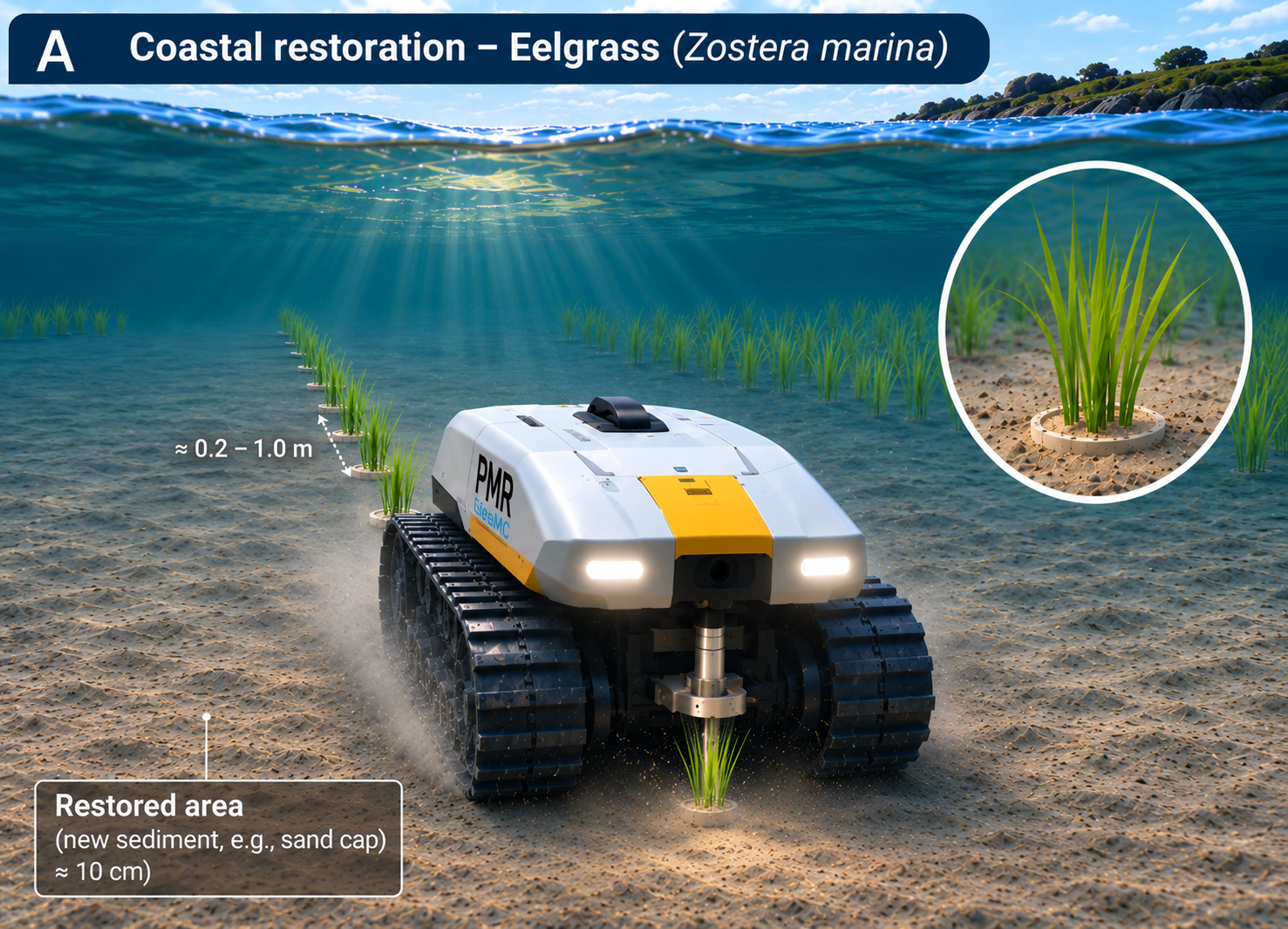
Our mission is to restore degraded marine ecosystems at scale by combining the principles of precision agriculture with marine biology, underwater robotics and digital environmental intelligence. We aim to make ecological interventions precise, repeatable and traceable, linking site assessment, robotic deployment and long-term monitoring to measurable habitat recovery.
Starting with eelgrass restoration in coastal waters, we seek to establish a scientific and technological foundation for future restoration of deep-sea habitats.
A multidisciplinary team with more than 20 years of experience across marine cultivation, seafloor robotics, sedimentology and marine ecosystems.
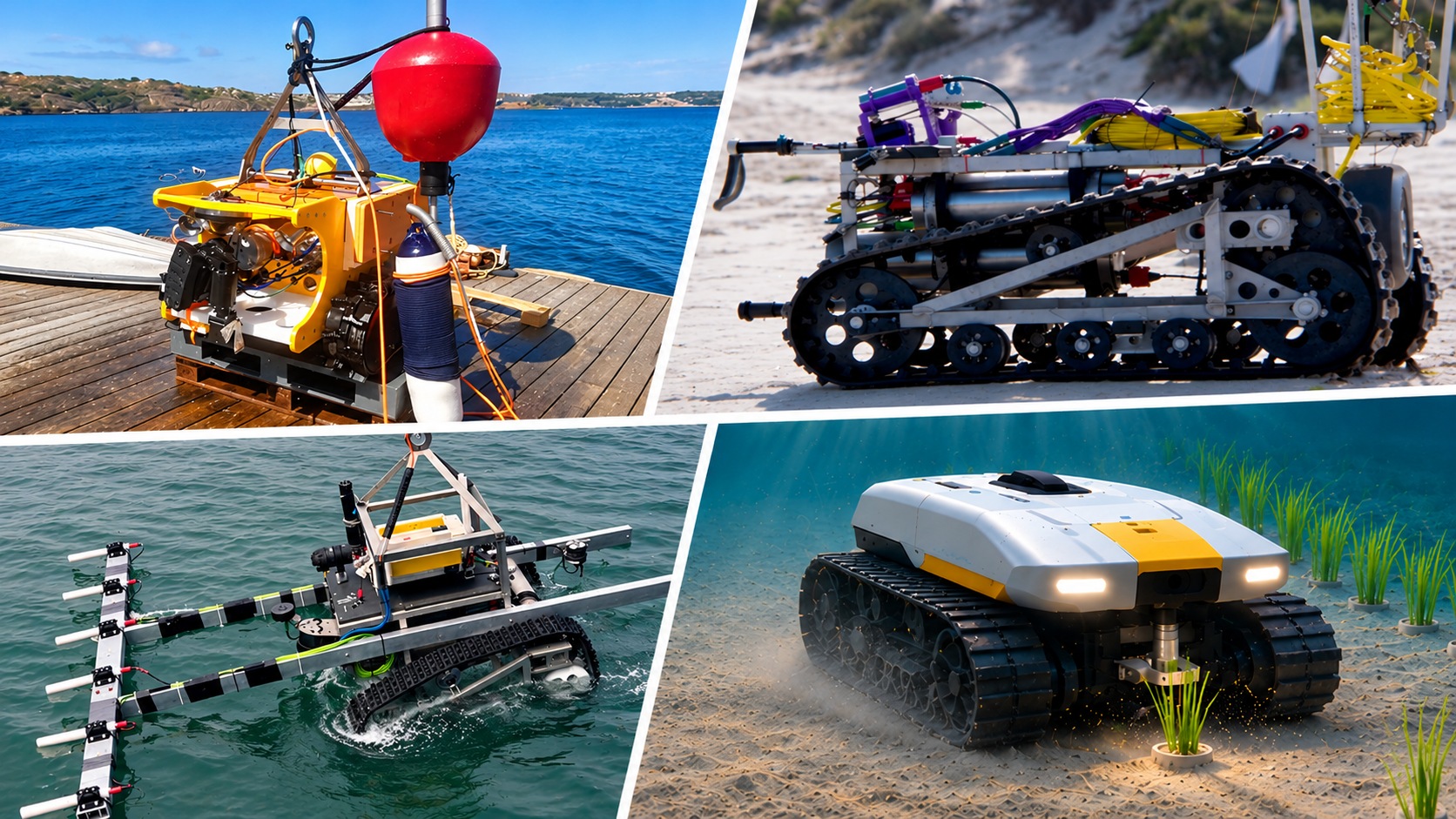
Cultivation, production, maintenance and handling of marine algae and other marine organisms.
Development and field operation of robotic systems for coastal and deep-sea research.
Marine sedimentology, habitat ecology, deep-sea ecosystem research and restoration science.
Our patent-pending Precision Marine Restoration (PMR) technology combines living organisms, standardized Benthic Support Modules (BSMs) and controlled robotic placement. With CAD designs completed, the technology is ready for prototype construction and experimental validation. Building on decades of hands-on experience in seafloor robotics, we can develop dedicated robotic carriers or adapt the technology to existing platforms. This modular approach is designed to support a wide range of species, habitats and operational environments.
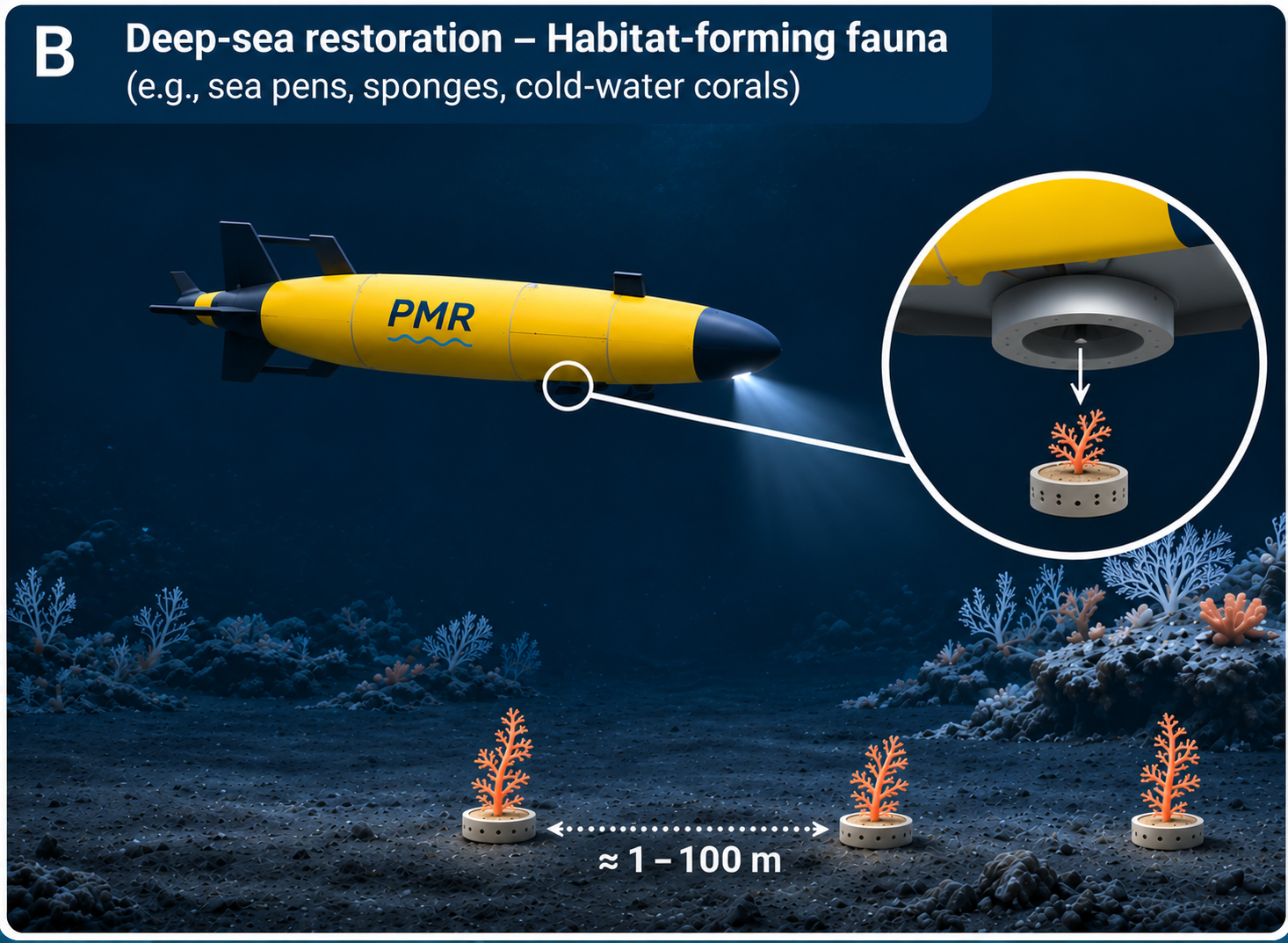
The key innovation is that the robot handles the standardized Benthic Support Module (BSM), rather than manipulating the living organism directly. Each module is designed to accommodate species-specific biological material, protect vulnerable organisms during handling and deployment, and provide secure anchorage in the seabed. The standardized interface is intended to withstand the tensile and compressive forces associated with robotic handling and placement while providing protection during establishment. This separates biological requirements from mechanical handling and enables repeatable deployment across different robotic platforms. These functions will be evaluated during prototype development and field trials.

Eelgrass (Zostera marina) forms productive coastal habitats, supports biodiversity, stabilizes sediments and contributes to carbon cycling. Successful restoration depends on suitable light, sediment and hydrodynamic conditions.
Our initial focus is robot-assisted eelgrass planting in Scandinavian waters.
We envisage adapting PMR to habitat-forming benthic fauna, including sea pens, sponges and cold-water corals. Species-specific deployment methods and ecological performance will require dedicated validation.
Under the EU Nature Restoration Regulation, restoration measures for marine habitat groups 1–6 not in good condition are subject to progressively increasing targets.
Regulation (EU) 2024/1991, Article 5(1), Annex II. Targets concern restoration measures, not guaranteed recovery; applicable statutory conditions apply.
Source: Swedish Agency for Marine and Water Management, Report 2025:14, pp. 17–18, 29–30. Planned area based on unpublished data cited in the report.
Our background spans university and SME research, international marine science collaborations and EU-funded research. This experience brings together biological cultivation, robotic engineering, field operations and digital observing networks.
Marine cultivation, company development and stakeholder engagement.
Sedimentology, environmental risk and impact assessment, marine restoration and seafloor robotics.
Marine robotics, Ecosystem function, observing networks and Digital Twin expertise. Coordinator of EU Digi4Eco.
Through its scientific advisors, iSeaMC is connected to an extensive European network of independent scientists and engineers active in major EU-funded research projects, including REDRESS and Digi4Eco. Their complementary expertise in habitat-forming organisms, marine restoration, underwater robotics and ecological monitoring provides a strong foundation for advancing restoration technologies through future collaboration. Stakeholder engagement spans the Swedish coast and Gothenburg, Catalonia and industry contacts. Research affiliations and stakeholder discussions do not imply formal company partnerships or confirmed pilot contracts.
 Supported by Innovatum Incubator
Planned milestones, subject to funding, engineering and field validation.
We welcome investors, industrial partners, port authorities, government agencies, restoration companies and research partners interested in developing and validating the next generation of marine restoration technology.
Contact usClaudia Thomsen, PhD · Founder
c.thomsen@iseamc.com